R&D · Methodology · 2026-06-15

Why first-attempt brand toolkits come out “safe,” and how to fix it on the first try.

The image model defaults to the average of every tasteful brand board it has seen — airy voids, mediumless vector, an untreated wordmark. The cure isn’t more iteration. It’s naming a medium, diverging before committing, and treating the toolkit as a direction-communicating Style Tile — with a safe↔bold dial. We tested it. The same model, on the same first attempt, went from generic to expressive.

13-agent investigation adversarial critique ×3 9-image A/B judge calibrated ✓ buildability held ✓
3–0
treatment beats control, blind forced-choice, every medium
+3.4
more expressiveness-rubric items passed (of 9)
3 / 3
treatments where the judge named a specific medium (controls: “none / clean vector”)
L2→L5
the safe↔bold dial moves monotonically — a real knob
01

The problem

The “safe AI board” is the model’s comfort zone

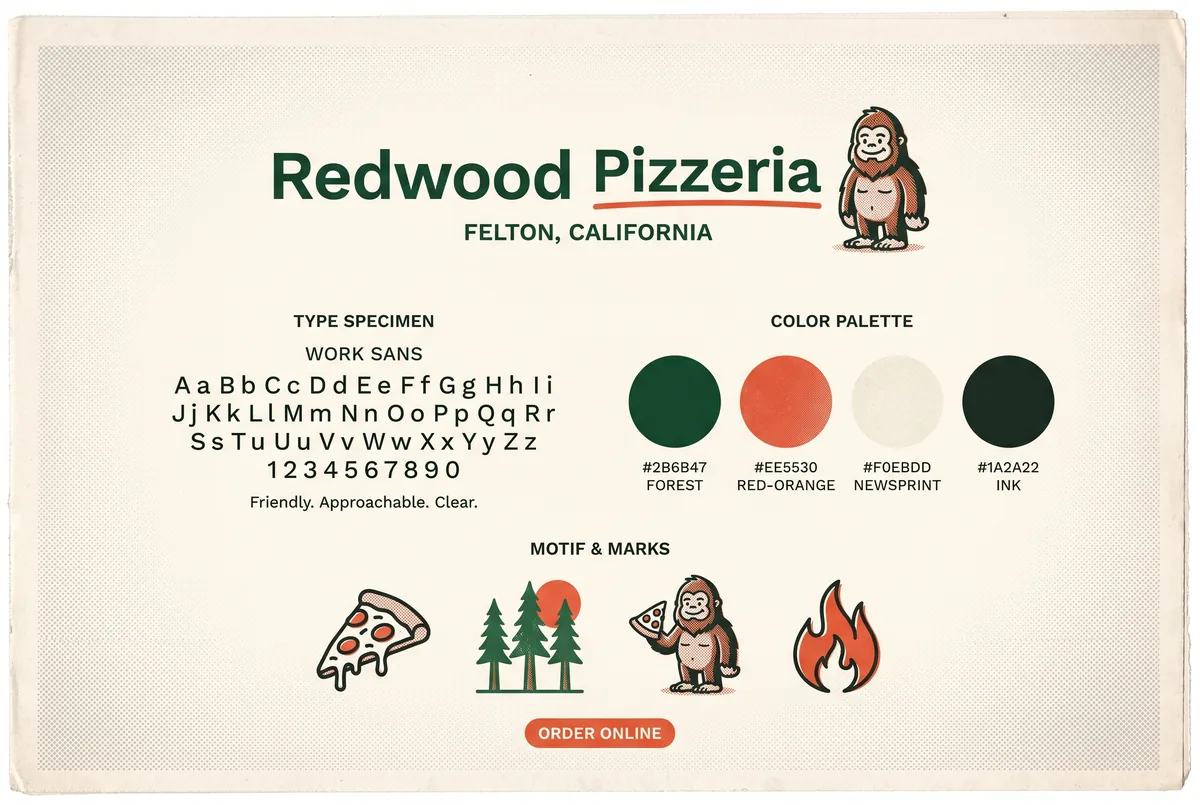
Ask for “a brand toolkit for a pizzeria” and you get the statistical mean: a cork-board of floating white cards, clean mediumless vector, a plain serif wordmark, tasteful pill swatches with caption names, and thin line-art icons. Competent — and completely generic. (This one even garbled FLAME → FLAM.)
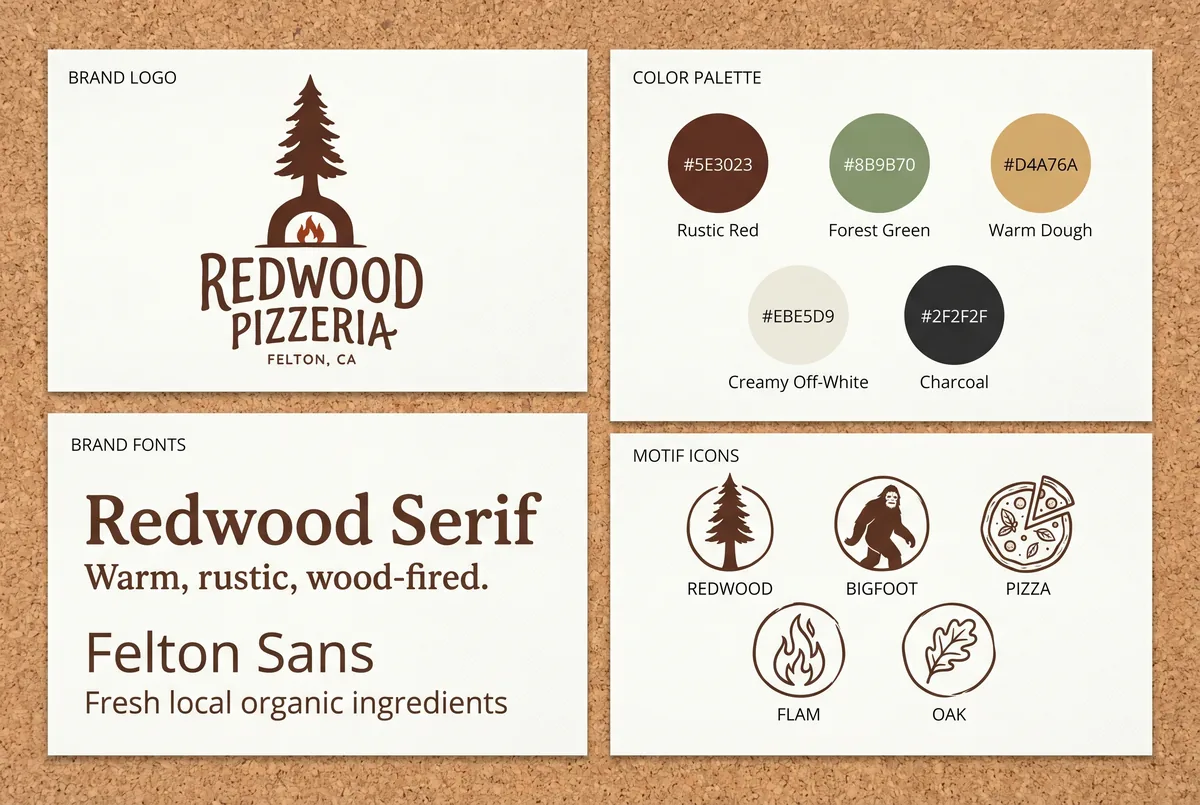
Control toolkit: a generic brand board
Exhibit A · control   The current process, first attempt. No medium. No point of view. No idea what the site will feel like.

This is not the model’s ceiling — it’s its default. Everything below is about overriding that default deliberately.
02

Diagnosis

Three compounding mechanisms — not one

Grounded in visual forensics across 16 prior runs, the impeccable skill internals, and external research on generative homogenization; then corrected by an adversarial pass.

Mechanism 1

Regression to the mean

An unconstrained ask lands in a dense “safe attractor.” The model supplies a specific medium readily when named — but never reaches for one unprompted.

Mechanism 2

No divergence step

The playbook generates one toolkit board, gated approve/redo — a 1-wide search. It even disabled the visual-direction probe. The first thing the user sees is one safe guess.

Mechanism 3

Failure-only rubric

The gate checks only colors-present / legible / no-chrome. A perfectly generic board passes every item. The toolkit is framed as a palette lock, not a direction it communicates.

The irony

The anti-generic intelligence already exists in the impeccable skill — the AI-slop test, reflex-reject lists, “Safe = invisible,” the Restrained↔Drenched axis. The graphic-craft playbook just loads none of it at the toolkit step.

03

The fix

Name a medium · diverge first · communicate direction

Six process changes (PC1–PC6), drafted as a proposal — the live playbook is intentionally untouched. The load-bearing move: reframe the toolkit from a swatch sheet into an in-medium Style Tile that predicts the mock.

The anatomy of an expressive toolkit

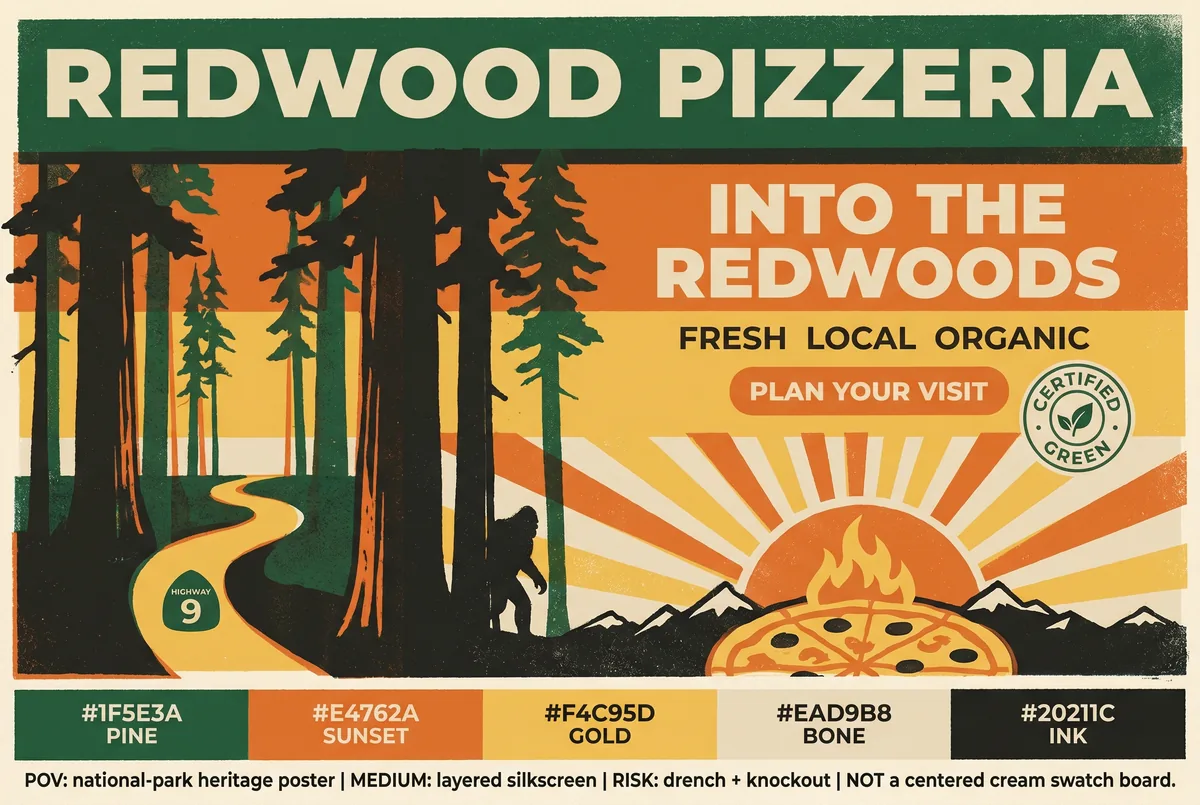
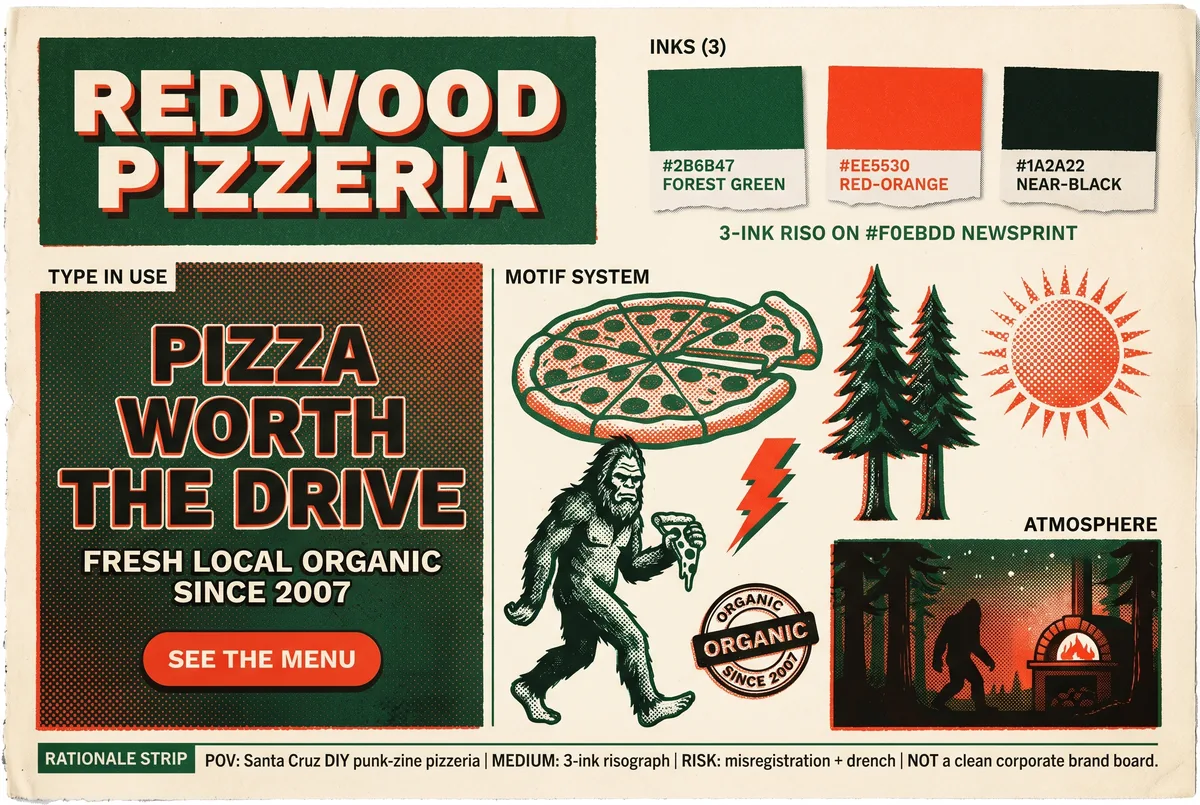
  • The board itself is in-medium (halftone, misregistration, ink bleed, grain) — not chips on neutral cream.
  • A treated wordmark (knockout / offset / paint), not a name set in a font.
  • Type shown in use — a real headline + subhead + CTA, not a font-name label.
  • An atmospheric vignette + a coherent motif system in one hand.
  • Hex swatches + a printed rationale strip (POV / medium / risk / anti-refs).

The six changes

#ChangeTier
PC1Divergence gate — 3 named “territory” boards firstadopt
PC2Toolkit → in-medium Style Tileadopt
PC3Positive expressiveness rubric (auto + human)adopt
PC4Medium+composition contract (out-of-band)adopt
PC5Branch, don’t “make it bolder”adopt
PC6SAFE↔BOLD dial (1–5), logged per runadopt

Flash scoring, exact divergence count, and verbatim-contract-in-prompt are gated behind validation — they touch unproven instruments or contradict an existing finding.

04

The experiment

Same model. Same first attempt. One variable.

Control = the current generic prompt. Treatment = named-medium-first + Style-Tile format + regression-to-mean patterns, at dial L4, across three distinct media. One attempt each, no human iteration. Wordmark fonts kept SAFE-tier (Work Sans / Playfair / Montserrat) so expressiveness never broke buildability.

control
control generic board · medium: “none”
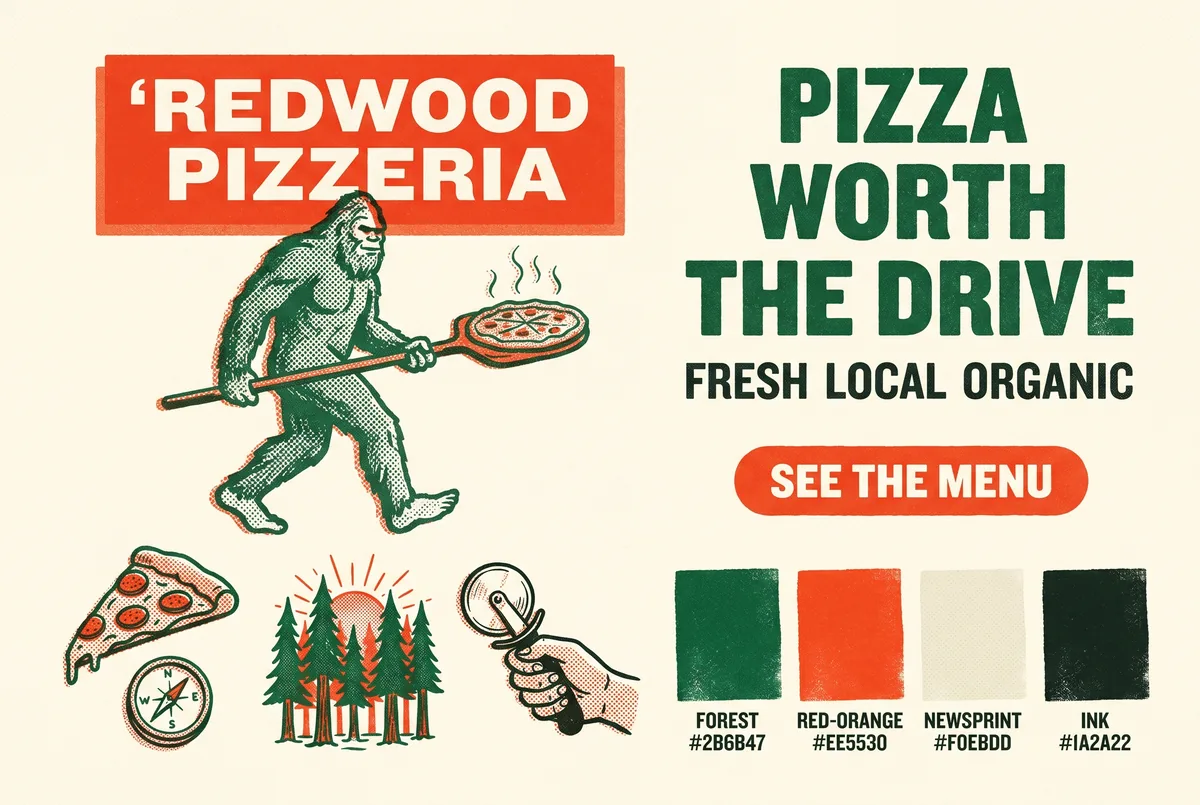
treatment riso
treatment risograph Style Tile

Three media, all first-attempt

riso
B1 · Risograph
boldest / most graphic
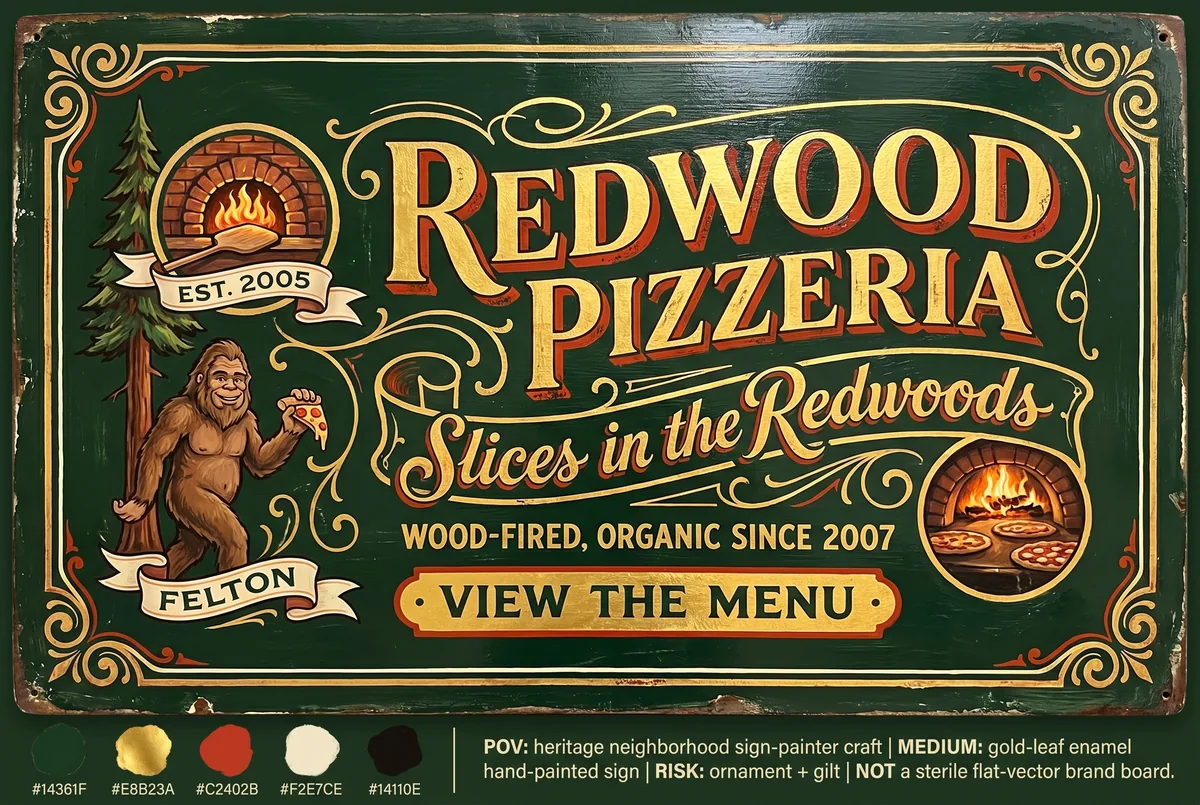
sign painter
B2 · Sign-painter
most hand-made / “non-AI”
silkscreen
B3 · Silkscreen
most iconic / buildable
05

Results

The treatment wins, and the judge agrees with the eye

Scored by a new calibrated Gemini-Flash scorer (the playbook’s flash_eyes.py can’t judge). It first passed calibration against human-labeled pairs (expressiveness 3/4, forced-choice 4/4), then scored the new images blind.

Expressiveness
control · 2.67
treatment · 4.0
Point of view
control · 2.67
treatment · 4.0
Rubric items
(of 9)
control · 4.3
treatment · 7.7

Per-cell scores

CellExprPOV/9Medium named
A1 control335none / clean vector
A2 control335none / clean vector
A3 control223none / clean vector
B1 riso447risograph
B2 sign448enamel sign
B3 screen448silkscreen

Blind forced-choice

ComparisonStronger POV
A1 vs B1 (riso)B · 3–0
A2 vs B2 (sign)B · 3–0
A3 vs B3 (screen)B · 3–0
L2 vs L3 (dial)bolder · 3–0
L4 vs L5 (dial)bolder · 3–0

Verdict

3 of 4 success criteria cleanly met; the 4th (mean-expressiveness +1.5) missed only at +1.33 — the judge’s scalar is compressed. The discriminating signals (unanimous forced-choice, perfect medium-naming, +3.4 rubric items) are decisive, and the human eye agrees.

06

The dial

Safe ↔ bold is a controllable knob

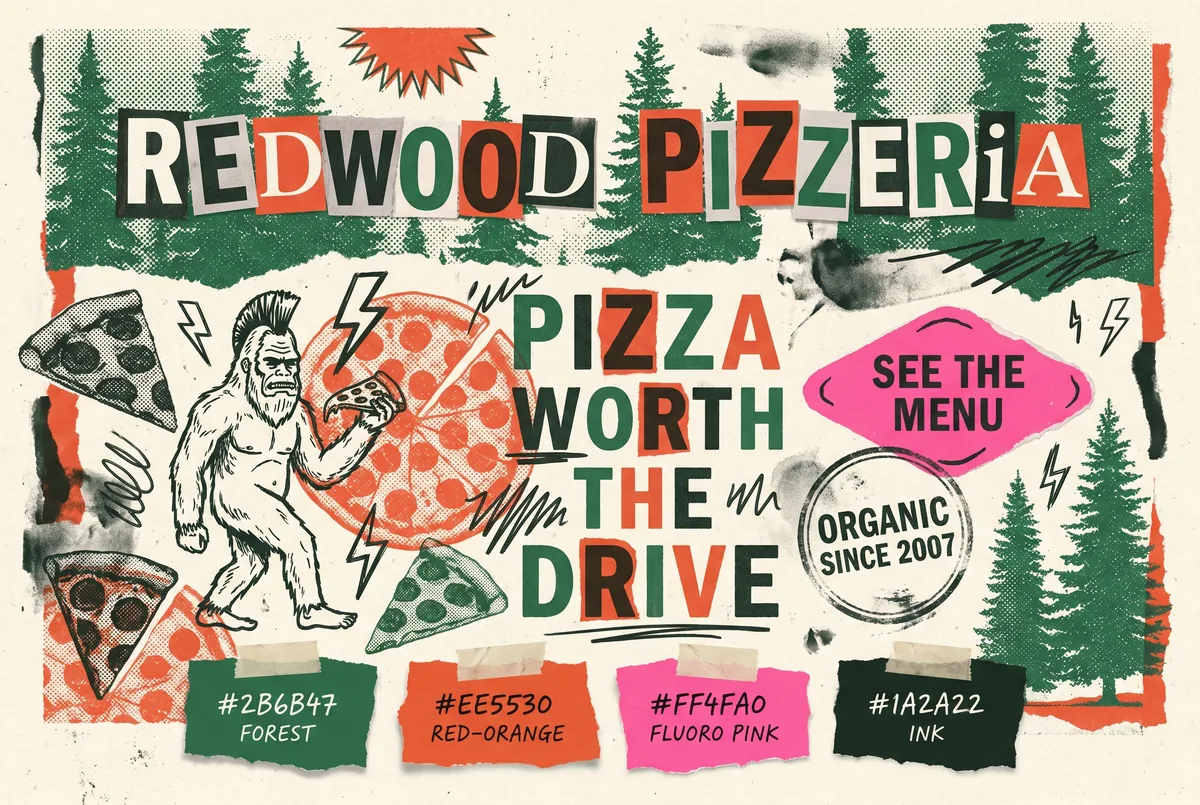
The same riso direction across four dial levels. POV climbs 2.67 → 3.33 → 4 → 4; rubric items 4 → 6 → 7 → 8. L5 breaks category codes — memorable, but it stops reading as “a pizzeria,” which is exactly why it’s opt-in only.

L2
L2 · familiar+twist
welcoming, recognizable
L3
L3 · distinctive
named medium, ownable mark
L4
L4 · bold
drenched, treated wordmark
L5
L5 · disruptive
punk-zine collage (opt-in)
safedefault → L3shippable cap → L4bold

Key nuance: the dial governs brand boldness; the toolkit’s own craft stays high even at L1–L2 — so a deliberately safe brand still ships a custom-looking, direction-communicating tile, never a generic one.

07

Buildability & what’s next

Expressive — and still shippable

The adversarial pass’s most valuable catch: the strongest expressive levers collide with the project’s hard-won build machinery. The guardrails keep an expressive direction buildable.

Guardrail

Wordmark font

Treatment (knockout/offset/paint) is metric-neutral — keep it. The font must be SAFE-tier or a fixed SVG logo; AVOID-tier display bakes narrower → HTML overflows.

Guardrail

Bounded drench

Flood feature bands only; exempt text-dense sections. WCAG AA contrast is a hard gate that outranks the density bar.

Guardrail

Out-of-band contract

Keep generation prompts minimal; carry the art-direction contract as a verification artifact, never pasted into the prompt (verbose prompts degrade font fidelity).

What this establishes

  • The diagnosis is actionable — one prompt-bundle change flips generic → expressive on attempt one.
  • The SAFE↔BOLD dial is a real, monotonic knob.
  • Buildability held — all treatments used SAFE-tier fonts + compositing-only treatments.
  • Flash can judge toolkit expressiveness, once calibrated.

Honest limitations & next

  • n=3 per arm, one judge family — a directional signal, corroborated by eye, not a powered result.
  • Downstream untested: does an expressive Style Tile yield an expressive mock + a buildable site? Carry one territory through Step 5 → build.
  • Apply the proposed edits to the live playbook — awaiting the go.